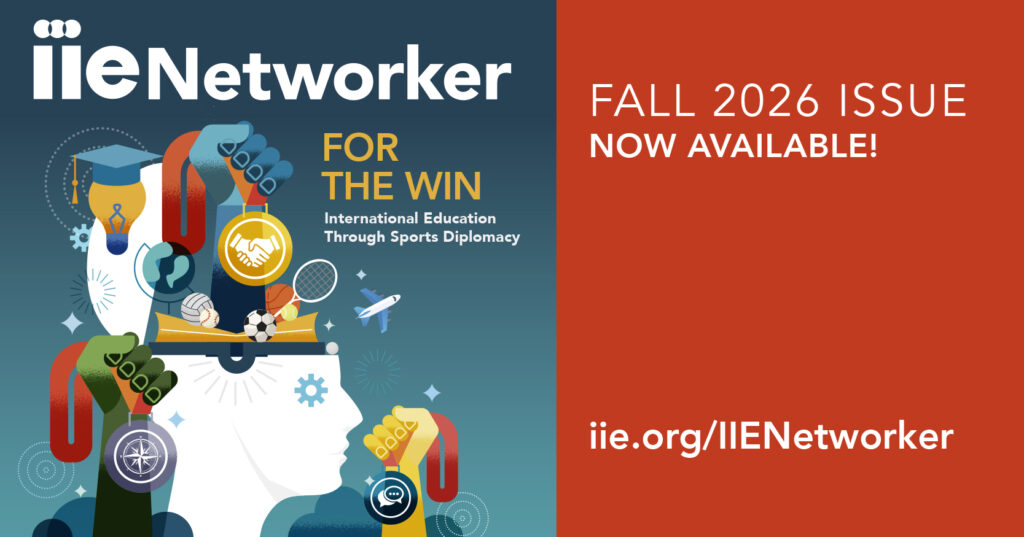
International education and sports diplomacy share a natural synergy: both create opportunities for people to cross borders, overcome communication barriers, and collaborate in ways that often outpace formal policy. Together, sports and international learning experiences help students cultivate the core professional capabilities that define success in today’s workforce: the ability to lead, communicate across cultures, adapt to new challenges, and work effectively in teams.
In the Fall 2026 issue of the IIENetworker magazine, For the Win: International Education through Sports Diplomacy, we examine this intersection, highlighting programs and initiatives that foster core professional competencies and intercultural learning through international sports experiences.
GET YOUR DIGITAL COPY
The magazine is only available in a digital format (PDF).
IIENetwork members with access to the Memberships Portal can obtain their complimentary digital copy of the magazine in the Resource Center. If there are questions about access, please email Membership@iie.org.
The IIENetworker magazine is available for purchase through the IIE Bookstore.
ARTICLE ABSTRACTS
By Deneyse Kirkpatrick, Founder & CEO, Kirkpatrick Global Strategies, LLC
As international education expands beyond traditional student mobility, higher education institutions are seeking new approaches to global learning, interdisciplinary collaboration, and workforce development. This article examines sport as an underused platform for advancing these goals. Rather than treating sport primarily as athletics, recreation, or short-term exchange, the article argues for integrating sport into institutional strategies for teaching and learning, research and innovation, workforce development, and global partnership. Drawing on examples from Africa, Europe, and North America, including the Sport for Education and Sustainable Livelihoods in Africa initiative and the U.S.-Mexico GOAL-WISE virtual academic exchange, the article illustrates how universities can move from event-based sports engagement toward sustained institutional collaboration. It proposes a practical framework through which higher education institutions can use sport to broaden access to international education, connect academic disciplines, prepare students for the growing global sports economy, and build reciprocal partnerships across borders. The article positions sport not as an end in itself, but as a platform for creating more integrated and enduring forms of international education.
By Sabrina Cortez, Study Abroad Advisor, Trinity University
This article explores Trinity University’s reciprocal sports diplomacy initiative connecting San Antonio and North Macedonia through volleyball, youth sport, and community exchange. Beginning with a North Macedonian delegation’s visit to San Antonio and continuing with a Trinity delegation’s travel to North Macedonia, the initiative demonstrates how sport can serve as a tool for citizen diplomacy, cross-cultural relationship-building, and global learning. The article reflects on how reciprocity, immersion, and intentional program design can move sports education abroad beyond observation and toward sustained partnership, shared curriculum, and more imaginative models of international education.
By Martha McGivern, Director of Study Abroad, DePaul University and Andy Clark, Director of Sports Business, DePaul University
This article is a program spotlight on DePaul University’s short-term, faculty-led study abroad program entitled England: The Business of International Sports in London. It illustrates how the program employs key values in sports – leadership, communication, adaptation, and teamwork – to help students develop career readiness in those core professional capabilities themselves.
By Sharon Witherell, Head of Editorial Fulbright Communications, IIE
This article explores how the Fulbright Program enables sports diplomacy by supporting students, scholars, and educators who use athletics to build relationships across borders. Drawing on examples of American student-athletes who have taken their leadership and teamwork skills abroad through Fulbright awards, as well as international Fulbrighters who engage with U.S. sports culture while studying in the United States, the article demonstrates how athletics can enrich educational exchange. From creating community-based sports programs and classroom activities to participating in collegiate and recreational competition, Fulbright participants use sport to foster dialogue, strengthen communities, and promote lasting international partnerships. Ultimately, the article highlights the role of sports diplomacy in advancing Fulbright’s mission of mutual understanding and preparing globally engaged leaders.
By Thalia Darnanville, European Project Manager, Strategic Partnership Development and Project Engineering, INSA Lyon
Balancing elite sport and academic studies abroad remains a significant challenge for dual-career student-athletes, yet international mobility offers transformative personal, athletic, and professional experiences. The SAMEurope Project tackled this issue by providing universities and students with practical tools to support international mobility. It has developed a Guide of Good Practices and its free interactive online platform helping student-athletes find universities that meet their dual needs. Recognized with a French Sport Management Trophy in 2025, the initiative offers dual-career students an easier path to study and train abroad successfully. The experience fosters personal growth, strengthens academic and athletic programs, and builds lasting cross-border collaborations. By integrating sport into international education, this initiative demonstrates how sport can serve as a strategic tool for international education, intercultural dialogue, and global learning.