Aymen Mohamed, Artist Protection Fund
Coming of Age Amid Revolution and War in Sudan: Aymen Mohamed Explores the Existential Through Visual Art
With Support from IIE’s Artist Protection Fund, Mohamed Published His First Book of Photography
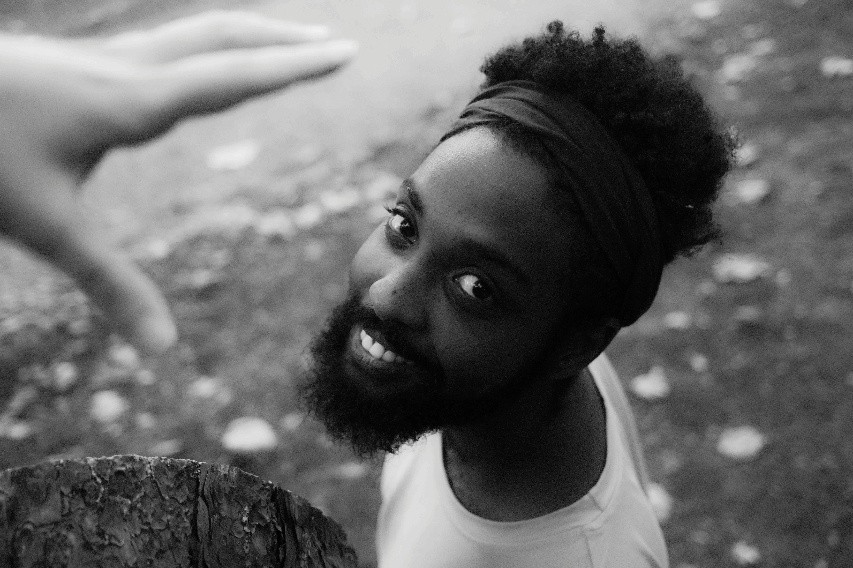
In August of 2019, Aymen Mohamed was celebrating his 21st birthday, but as he was stepping into adulthood, his home country of Sudan was engulfed in a revolution. After 30 years under the repressive Omar al-Bashir regime, the people of Sudan were demanding a return to democracy. The months-long journey to get there would be deadly and unpredictable. Conflict would become a constant force in Aymen’s life.
Sudan’s 2018 revolution, the 2021 military coup, and the ongoing armed conflict—which has displaced more than 10 million people—collectively inspired Aymen to channel his observations and experiences into his visual art practice. “The interplay between the self, society, and the environment has emerged as a central theme in my practice,” he says of his creative approach. “In this journey, I have chosen to become both the subject and the witness—placing myself at the center of the inquiry.”
For Aymen, studying visual arts provided an opportunity to develop his vision—and relief from the harsh realities of life in Sudan. He went abroad for several years, earning a bachelor’s in film from the South African School of Motion Picture Medium and Live Performance and a master’s in photojournalism from the Danish School of Media and Journalism. Aymen was eager to return home and apply the advanced skills he had gained. He eventually realized, however, that his creativity could not flourish amid war and instability. “It was a moment of deep exhaustion,” he said.
Determined to preserve his creativity, Aymen began searching online for international opportunities. That’s when he found and successfully applied for IIE’s prestigious Artist Protection Fund (APF). As a 2025 APF Fellow, Aymen received a grant and a one-year residency at the esteemed Jan van Eyck Academie (JVE) in The Netherlands. The APF Fellowship provided him with a home, dedicated studio space, opportunities to develop new film projects, mentorship, and a vibrant community of fellow artists.
“The APF Fellowship gave me something I very much needed—time and space,” he says. “When you are caught in the middle of conflict and displacement, the mind does not get to rest, and creation becomes almost impossible. The fellowship created a space where I could finally slow down and sit with the questions that had been piling up inside me—questions about where I am from, what I witnessed, and what any of it means.”
Aymen’s APF Fellowship also unlocked access to materials and a printing lab, where he would go on to produce his first book of photography, Scent of Days (2025). Recalling his time at JVE, Aymen says, “Something about being in that room—producing a work I had wanted to make for a long time—made me feel very much alive.”
Aymen’s introspective methodology comes into full view in Scent of Days, which invites viewers into Aymen’s interior world and functions as a physical representation of his memory of Sudan after the revolution. By presenting nonsequential black-and-white photographs, Aymen is asserting that memory is something “…entered, exited, and revisited…” His objective, he says, is not to answer questions, but to facilitate an infinite dialogue between the flow of time, memory, and interpretation.
In addition to his multidisciplinary practice in film and photography, Aymen documented the unforgettable scenes of the 2019 Khartoum massacre, a defining moment in Sudan’s revolution. The emerging artist and pro-democracy activist is just getting started. He is now developing a broader archival project that seeks to offer an insider’s account of conflict throughout Sudan’s history. “Whether I’m making photographs, videos, or working in another form, I’m searching for moments that renew my ability to see with curiosity, openness, and awe.”
By offering his own reckoning with events at home, Aymen wants to encourage artists from conflict-affected places to remain endlessly curious and to recognize that they have a voice capable of engaging with difficult questions.
He concludes: “Supporting APF is not just about supporting art. It is about protecting something far more fundamental—the right of a human being to remain whole.”
The Artist Protection Fund works to protect threatened artists by providing fellowship grants, resources, and placements at host institutions in safe countries, enabling them to continue developing their creative work.